
My local group wrapped a four-session mini-campaign of White Line Nightmare, my game of outlaws in an apocryphal 1970s retrofuture. We hit some speedbumps but overall each session was fun and my players’ feedback was constructive and validating.
It’s All About Family
Six players makes for a big crew, and we were able to cover just about all the traits in the game.
- Edith Steele, a whistleblower and phone phreak trying to open source the world.
- Barrett Mueller, a renegade ex-cop who can’t leave a situation unfucked. Inspired by several Thomas Jane characters, all at their maximum bedragglement.
- Isaac Döll, victim of automation. His father was worked to death by Relife and now he’s trying to shatter the status quo in New Hope City.
- Royce, a vet caught up in a vendetta against the vicious Scumlords crew. His war never ended.
- Mattys Bara, a former cultist with the Glorious Order of the Black Sun who stole the leader’s prototype thinking car. Mattys has to destroy the cult to be free of it.
- Tori Talos, a bionic woman, illegally upgraded by the Relife corporation. She escaped and they want her back.
Gameloaf, or A Recipe For Disaster
White Line Nightmare’s a gameloaf. Roleplaying games have been around for long enough, and I’ve been around them long enough, that I can probably point to any given rule and say where I’ve seen it before.
And that is okay.
It’s not about creating brand new individual rules, especially if I want my extremely-patient players to continue playtesting my chimeras. It’s about using familiar ingredients, adding a pinch of novelty, and hopefully you end up with mechanisms that lead to fun and rewarding gameplay.
The Risk Die
I wanted players to make choices each time we went to the dice, which led to WLN using a very small dice pool comprised of:
- The skill die: The GM chooses what skill is most appropriate.
- The approach die: The player chooses how their character approaches the situation. This is more than characterization or simply choosing the largest die – the approach you choose guarantees certain aspects of how your action is resolved and influences any consequences.
- The risk die: The numbers are skewed a bit to make success fairly difficult without also choosing a risk die. This third die helps avoid failure but might also prevent you from succeeding cleanly.
Minigames!
A big part of my playtest campaign was subjecting introducing my players to a variety of minigames.
- Shootouts: The shootout minigame is essentially a player-facing skirmish miniatures game. Although there are a lot of weird backwards concepts compared to trad and trindie combat, I think that the handful of firefights we had over the course of the game worked out pretty well. Everything ran quickly and degraded elegantly when I forgot a rule or two, which honestly is an important part of any game.
- Elevator Fights: An amusing shorthand for “any melee fight you want resolved in one or two rolls”, this minigame was the standout winner to me. High stakes and fast resolution every time, it owes a lot of its inspiration to the I Corner Him And Stab Him In The Face roll from Burning Empires. We even put elevator fights inside shootouts, because Tori eschewed firearms in favor of running up on people and clobbering them.
- The Brawl: There were two versions of brawling. My first version was card-based and relied on a grid for positioning. It had potential but I had to really railroad a situation where weaponry wasn’t an option. It turns out it’s also quite difficulty to balance a card game. Go on, ask literally any game designer. The standout mechanic for this minigame was the initiative system, where you choose cards to play each round and you act slower the more cards you choose.
- The Second Brawl: I introduced an dice-not-cards alternative brawl for our final game that was inspired by Sifu and the Arkham games, where countering is sometimes more important than offense. I like the feel of this second brawling game – it definitely runs faster and has a satisfying amount of forced movement and knockdowns. It also didn’t require quite as much contrivance to get to the table.
- The Car Chase: I’m happy to say that we had several chase scenes across the campaign and they all worked, even with multiple PCs driving multiple vehicles, leaping from one vehicle to another, exchanging gunfire, and a helicopter to complicate things. I’m not entirely satisfied with the hunter’s role in the chase minigame. The risk die you choose for your roll is added to an ever-growing chase pool that you can “cash in” to stop your quarry. It’s simple push-your-luck and it works, but it doesn’t hit that sweet spot as well as the die drop table I have for when you’re the quarry and you’re trying to escape.
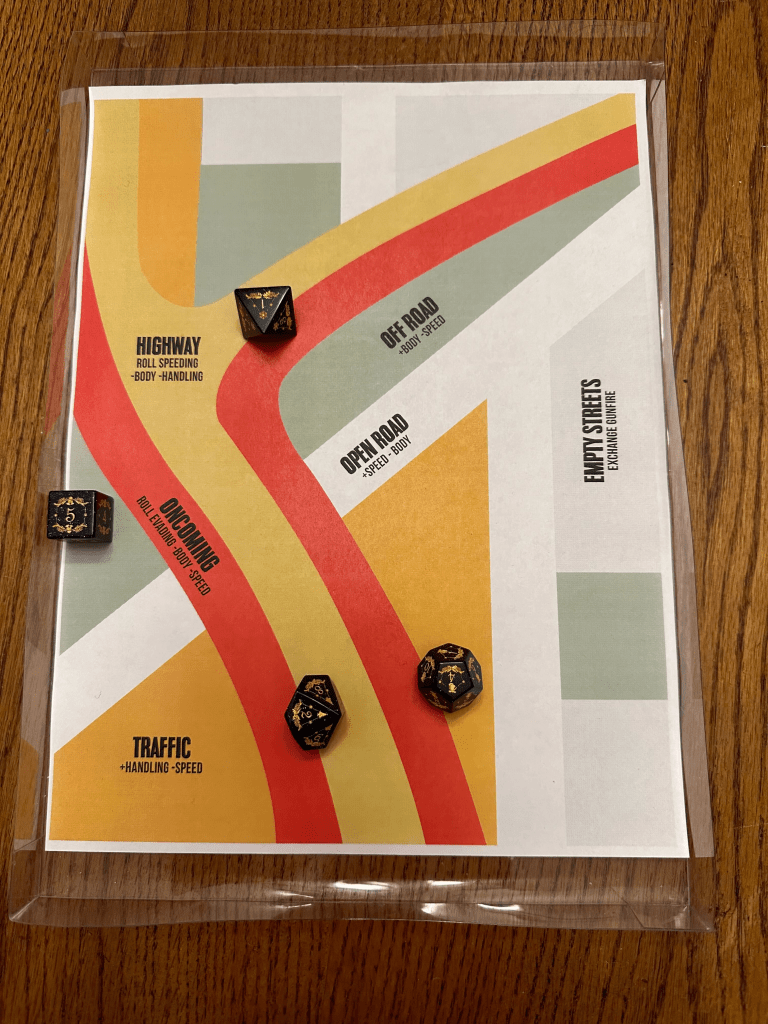
I learned that hit locations for vehicles are Good, Actually. They’re more work than hit points but since cars and choppers aren’t living, cohesive organisms like people, a blown tire should act differently than a fuel leak or transmission damage.
Achievement Unlocked
I made a lot of changes to advancement during our handful of sessions, but a major win was requiring players to accomplish certain tasks to unlock special moves they wanted to buy with their XP. I didn’t want anything too esoteric, too luck-dependent, or rely too much on GM fiat for providing the right situation.
Dig Two Graves: When you are downed in a shootout, you down the enemy who hit you.
Achievement: Get payback on someone who hurt you.
“Get payback” can be interpreted very loosely, and it influences your choices and actions as well so by the time you have the special move, it makes sense for your character.
What Next?
- My group’s moved on to planning our next campaign and trading GM duties, but when it’s my turn again I can totally see myself running some more White Line Nightmare.
- I’ve already done some skill swaps to make a dinosaur-park-themed game for my kids. I’ll need some different minigames, though, like a “hiding from raptors” activity.
- I know I want to finish writing this up, but I’m not sure what form it should take. Right now I’m considering putting the basic system up as pay-what-you-can, then building out minigames like DLC. That would allow me to playtest each without waiting for everything to be ready.
- Yes, I will probably end up using White Line Nightmare to run Star Wars.
A Random Shout-Out
Finally, everyone in the world knows about Helldivers 2 but I want to tell you about Heading Out, the only video game that managed to drag me away from dropping bombs on bugs. It’s an allegorical roguelike visual novel driving game built on a foundation of Vanishing Point and I was apparently its target audience.

 Don't Roll a One
Leave a comment